-
Arrival at Pearl City
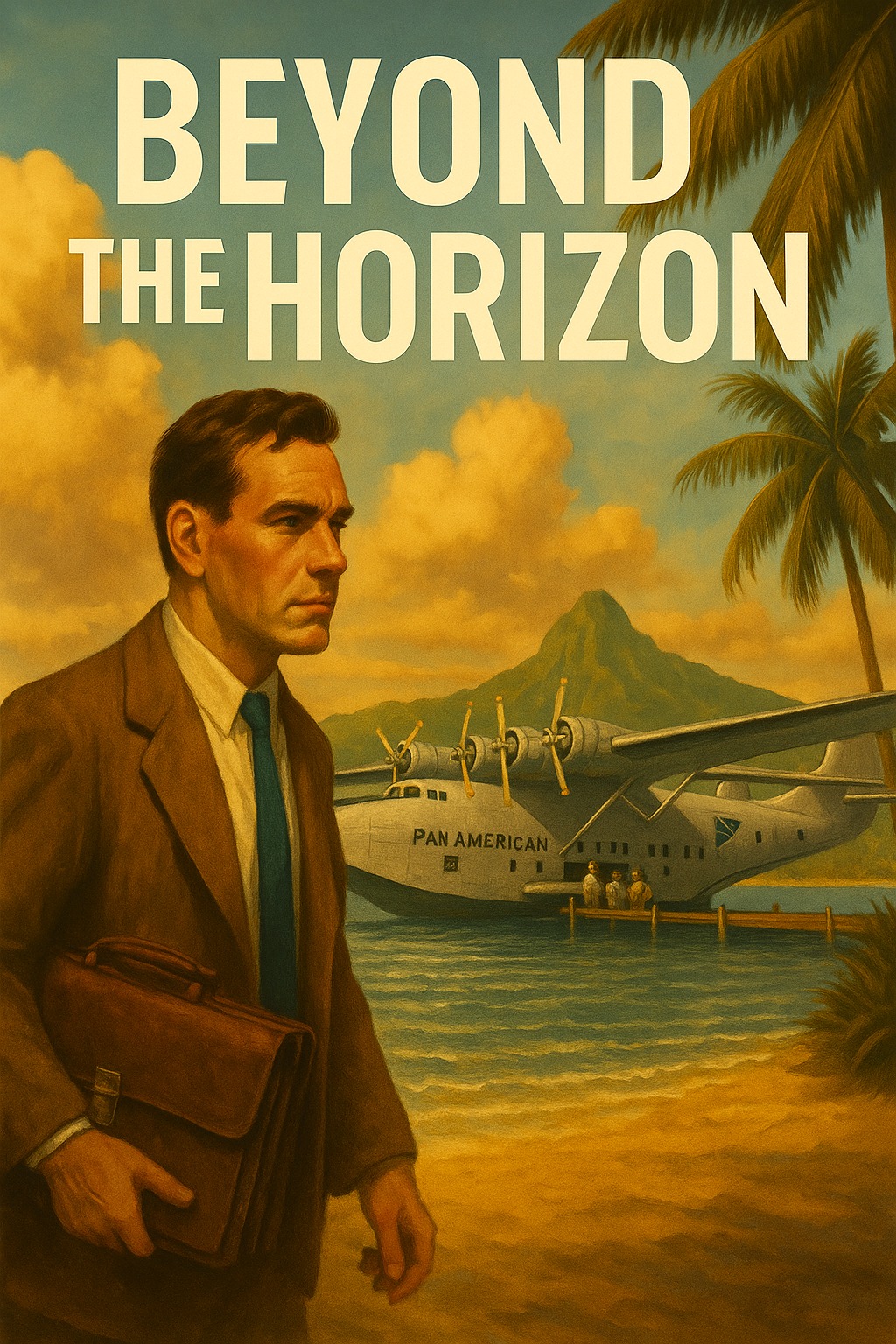
Late afternoon sunlight bathed the Pacific Clipper as it touched down gently on the waters off Pearl City Peninsula, its hull cutting through the harbor's surface with practiced grace.
Professor Michael Kay, a man of slender build and thoughtful eyes behind wire-rimmed spectacles, emerged from the side hatch, squinting slightly against the brightness of Hawaiian sunshine that seemed to magnify everything it touched.
At thirty-two, Kay possessed the kind of focused intelligence that had earned him recognition at MIT's Radiation Laboratory, where his work on electromagnetic detection systems had begun attracting attention from military circles.
His heart raced with the thrill of what lay ahead - new technology and the promise of advancement in the realm of radar that could revolutionize how wars were fought and won.
The flight from San Francisco had been long and contemplative, giving Kay time to think about the classified materials that he had read the night before departing.
The technical specifications for his enhanced radar system, codenamed "Tinkerbell", represented months of intensive calculation and experimentation.
If his theories proved correct in field testing, the system could detect aircraft or naval formations at distances that would make current military radar seem primitive by comparison.
As he navigated the steps to the bustling terminal heading towards the luggage dock to collect the equipment crates he had brought with him, the sounds of planes, ships, and distant conversations enveloped him in the unique cacophony of a major Pacific hub.
Seaplanes lifted off and touched down with clockwork regularity, their spray patterns catching the afternoon light.
A calendar on the wall caught his eye as he passed through the arrivals area: Tuesday, December 4, 1941. A date that would be marked in his mental timeline, a point from which new strides in technology might leap forward into an uncertain future.
The terminal buzzed with an undercurrent of tension that hadn't been there during his last visit six months earlier. Military personnel moved with purpose through civilian crowds, their conversations hushed but urgent.
Even the normally relaxed Hawaiian airport workers moved with unusual briskness, and passengers checked departure boards with uncharacteristic intensity.
As he passed a news stand, Kay could not help but notice the headline in one of the newspapers-"Sharper Watch in Hawaii" printed in bold letters that seemed to leap off the page.
Below it, in smaller but equally ominous print: "Military Increases Patrols Amid Rising Pacific Tensions." Other headlines caught his attention: "Diplomatic Talks with Japan Continue" and "Roosevelt Calls for Pacific Vigilance."
The vendor, an elderly Hawaiian man with worry lines etched deep around his eyes like carvings in weathered wood, caught Kay's gaze and shook his head slowly.
"Scary times, Professor," the man said, recognizing Kay from previous visits. His voice carried the weight of someone who had lived through enough history to recognize when it was about to make another violent turn. "My grandson works at the naval yard. Says they got all the boys working overtime, checking and double-checking everything. Ships coming and going at all hours, planes flying patterns he ain't never seen before."
The vendor leaned closer, lowering his voice. "He tells me the harbor's so full of ships they barely got room to maneuver. Pacific Fleet's all here - too many big ships in one kalo patch, yeah? Makes an old man nervous, you know?"
Europe was already at war, and many in the United States government were increasingly concerned about Japan's aggressive moves in the far east and what future plans they might have for American interests in the Pacific.
Kay had read the classified materials previously - intelligence reports spoke of unusual Japanese naval movements detected by long-range reconnaissance flights, diplomatic communications growing increasingly hostile with each exchange, and a sense among military analysts that something significant was brewing across the Pacific region. Intercepted communications suggested major Japanese fleet movements, but their destinations and intentions remained frustratingly unclear.
Suddenly, a familiar voice, rich and resonant with the enthusiasm that made him such an effective research partner, cut through the din. "Professor Kay! Over here!"
Tom Ridley, his assistant and confidant, stood next to a battered Army jeep that looked like it had seen service in every climate from tropical to arctic. His khakis were wrinkled, his sleeves rolled high. Ink stains marked his fingers like battle scars from a long night of calibration.
Ridley, with his unruly brown thinning hair that never quite cooperated with any amount of pomade and an eager demeanor that made him seem younger than his twenty-eight years, was usually a contrast to Kay's calm composure. He'd been this way since MIT - Kay remembered it well. A brilliant graduate student who could visualize radio wave paths like an artist sketches light, but who sometimes forgot to eat while buried in equations.
Ridley had grown up in western Massachusetts, the son of a telephone technician who used to let him take apart discarded receivers to "see how voices fit inside the wires." The boy who once strung homemade antennas across barn rafters was now the man orchestrating the most advanced radar field test in the Pacific.
But today, even Ridley's characteristic enthusiasm seemed tempered by an underlying nervousness that showed in the tension around his eyes and the way he kept glancing at the sky.
"Good to see you made it," Ridley said, clapping Kay on the shoulder with perhaps more force than necessary. "How was the flight? Any problems with customs? I was worried they might give you trouble with all that equipment."
"Long, but worthwhile," Kay replied, his thin fingers adjusting his glasses as he noted how his assistant's usual energy seemed oddly restrained. "It gave me time to think over the tests and review the latest changes to the detection routines. How are things on your end? You look like you haven't slept in days."
Ridley ran a hand through his disheveled hair, a gesture Kay recognized as a sign of significant stress. "Well, you're not wrong about the sleep. The whole island's been on edge since that war warning came through from Washington last week. Everyone's jumpy-every fishing boat gets scrutinized by patrol craft, every civilian plane gets tracked twice and questioned about its destination and cargo."
He lowered his voice and moved closer, glancing around to ensure their conversation remained private. "There's talk among the radar operators that they're picking up ghost signals, things that don't make sense on their scopes. Could be atmospheric interference from all this tropical weather, could be equipment malfunction from the salt air, or..."
"Or it could be exactly why we're here," Kay finished, his scientific curiosity overriding his travel fatigue.
The possibility that his enhanced detection system might be arriving just in time to solve a critical puzzle sent a familiar thrill through his mind-the excitement of seeing theory meet practical application under circumstances that truly mattered.
"Promising," Ridley responded, his eyes lighting up despite his obvious exhaustion. "I've secured a fishing vessel for our offshore tests-Captain Jim Akana's Kilokilo Maru. She's no Navy cruiser, but she's reliable and has the electrical power we need for the equipment.
Captain Akana's been sailing these waters for thirty years, knows every current and wind pattern. If anyone can help us test this new detection system properly under real maritime conditions, it's him."
Ridley continued, his voice taking on the technical enthusiasm that Kay knew so well. "I've already run preliminary calibrations on the existing radar equipment at Opana. The atmospheric conditions here are actually better than we predicted for long-range detection. The temperature gradients and humidity levels create some interesting propagation effects that might actually enhance our range."
Kay nodded, his mind already racing through the logistics and technical challenges ahead. The enhanced radar system they'd developed at MIT could theoretically detect aircraft formations at much greater distances than current military radar-perhaps as much as 300 miles under ideal conditions, compared to the 100-120-mile range of existing installations.
If their calculations were correct, it might provide the kind of early warning system that could change the entire strategic equation in the Pacific.
"Excellent work, Tom. Let's get the equipment loaded and head straight to Opana. I want to see the setup there before we test the new system at sea. The Army is counting on us-and from what I'm seeing here, time may be more critical than anyone realized."
Ridley checked his watch, already calculating the drive time. "Colonel Davidson wants to brief you personally. He's been asking about your arrival all week - called the terminal twice a day.
We'll stop by the harbor warehouse first to unload the gear we'll need at sea, then head north to Opana. I'll get you settled in afterward."
They began loading Kay's luggage and equipment cases into the jeep, each item handled with the care reserved for delicate scientific instruments. The cases were marked with cryptic numbers and letters that meant nothing to casual observers but represented months of intensive research and development. The largest held the heart of their system-a modified magnetron capable of generating radar pulses with unprecedented precision and power.
"Unfortunately," Ridley said as they secured the equipment, "the only space the Army could give us for our shore-based station is an old gardener's shed just down the hill from the main Opana Radar Site. It's not much to look at-probably hasn't seen fresh paint since the last territorial governor left office-but it's got power lines running to it, and it's close enough to coordinate with the main installation for triangulation readings."
Kay paused, having loaded a heavy equipment case halfway into the jeep. Something in Ridley's tone, a carefully neutral quality that he'd learned to recognize over months of working together, suggested there was more to the story. "What aren't you telling me, Tom?"
Ridley glanced around the increasingly busy terminal, then leaned closer. "The shed wasn't their first choice for our operations. They moved us there three days ago. Apparently, our original location was deemed 'too visible' by intelligence officers. They're worried about... observers."
The word hung in the air between them, carrying implications that both men understood but neither wanted to voice directly. Kay felt a chill of recognition-the kind that came when theoretical threats suddenly became concrete possibilities.
"It won't be the first time we've had to make do with less than ideal conditions," said Kay with a resigned grin, though privately he wondered what kind of observers would be watching American military installations with such systematic interest that it required relocating their experimental radar station. The implications suggested intelligence concerns that went far beyond routine security measures.
As they drove away from the terminal, navigating through streets that seemed to carry more military traffic than usual, Kay noticed something else that struck him as significant-the harbor, normally busy but organized with the efficiency of peacetime routine, seemed almost crowded. Destroyers nested alongside cruisers, while the massive silhouettes of battleships tied up at Ford Island dominated the harbor's center like sleeping giants.
"Tom," Kay said as they navigated through increasingly numerous and thorough military-controlled checkpoints, each one staffed by soldiers who examined their credentials with unusual care, "just how many ships are currently anchored in Pearl Harbor? It looks like half the Pacific Fleet is here."
"Most of the Pacific Fleet, actually," Ridley replied grimly, his voice carrying a weight that made Kay look at him sharply. "They've been concentrating forces here for weeks. Battleships, cruisers, destroyers-the whole battle line. Arizona, Oklahoma, West Virginia, all the big guns.
He gestured toward the harbor, where the midday light was beginning to reflect off the water and the hulls of dozens of warships. "Admiral Kimmel's got them all here for what they're calling 'readiness exercises,' but everyone knows it's really about putting on a show of force. Problem is, when you concentrate that much firepower in one place..."
Kay felt a chill that had nothing to do with the ocean breeze. His experimental radar system, originally conceived as an interesting technical challenge with potential military applications, might be arriving at exactly the moment when it could prove more crucial than anyone had imagined.
He thought of his father, the machinist from Worcester who had encouraged his interest in engineering, who had been proud when Kay earned that scholarship to MIT at sixteen. His father built things that helped people. Would he be proud of what Kay was building now?
He thought of Mary - Mary Berman, who he'd met at MIT, who'd been patient with his social awkwardness, who'd understood his perfectionism. Two years of marriage before cancer took her in 1939. She'd helped him see the larger human context of his work, the ethical dimensions he tended to overlook when lost in equations.
What would Mary think of this? Of radar systems designed to detect threats so they could be destroyed more efficiently? He pushed the thoughts away, as he always did. When faced with emotional challenges, retreat into technical problems. That was his pattern. That was his survival mechanism.
The peaceful Hawaiian afternoon suddenly felt charged with possibilities he hadn't considered during the long flight from California. "Tom," he said quietly, his voice losing some of its usual precise quality as emotion threatened to break through, "I think our testing schedule just became a lot more urgent."